
Fertilized vs Unfertilized Goldfish Eggs: How to Tell Them Apart
Right after a spawn, every egg on the plants or mop is a tiny, sticky, clear bead. Wait a day or two, though, and they sort themselves into two groups you can see with your own eyes.
Fertilized eggs stay clear. In water around 70°F (21°C), the Bristol Aquarists’ Society says you’ll see two little black eyes and a curved line after about two days. Infertile eggs typically turn white, and they won’t hatch.
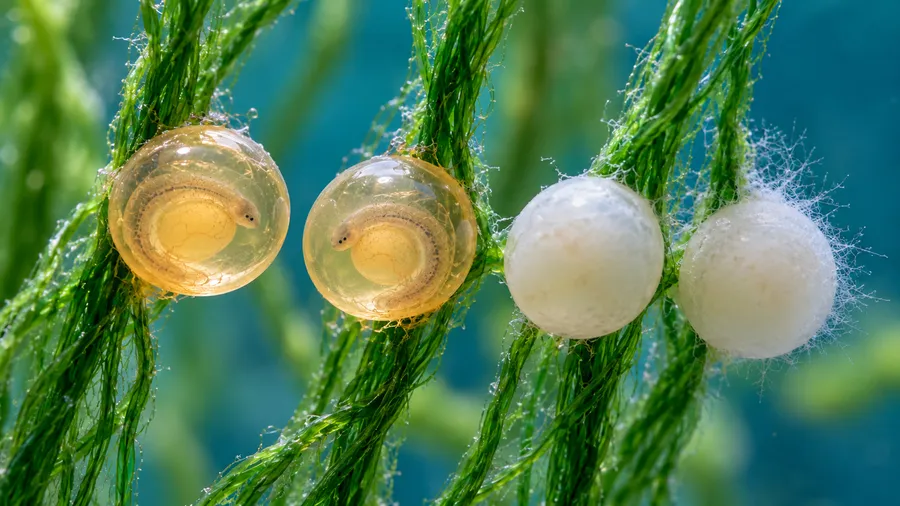
| What you see | What it means | What to do |
|---|---|---|
| Clear, with two black eyes | Developing | Leave it alone and keep the water steady |
| Clear, no eyes yet | Too early to tell | Check again tomorrow |
| White or cloudy | Usually unfertilized | Lift it out with a pipette if you can do it gently |
| Covered in gray-white fuzz | Fungus has set in | Remove it, since fungus can attack good eggs too |
How to check your eggs
Wait until the second day before you sort anything, since that’s when the Bristol notes say infertile eggs start to look furry. Cooler water slows things down. In a 2023 study of goldfish eggs, the eyes took about 68 hours to darken at 64°F (18°C), compared with 43 hours at 72°F (22°C).
Hold a light behind the plant or spawning mop and look closely, or use your phone’s camera zoom. The eyes are tiny, so it helps to check several eggs before you decide how the spawn went.
Why some eggs are never fertilized
Goldfish eggs are fertilized outside the body, when a male releases milt around them. If a female drops eggs with no male in the tank, none of them can develop.
Even with a male present, some eggs miss out. The Bristol notes describe spawns with some infertile eggs mixed in among the ones that develop.
Fungus and what to do about it
Practical Fishkeeping says infertile eggs are particularly prone to fungus, which shows up as gray-white fluffy growths. Fertile eggs can be affected too, and the fungus can kill the young fish inside.
The same article mentions methylene blue as a way to prevent egg fungus, but warns that it destroys filter bacteria. Use it only in a separate container, never in a tank that relies on its filter.
How many eggs should hatch
In the same study, 97% of eggs kept at 72°F (22°C) hatched, and 81% hatched at 64°F (18°C). The researchers found no real difference in hatch rates anywhere from 64°F to 86°F (18°C to 30°C). Those eggs were fertilized by hand in a lab, so your own numbers may differ.
Once you spot eyes, hatching usually isn’t far off. See how long hatching takes at your water temperature, or count down with the tracker below.
If the eggs are still in with the adults, move them first. Fancy goldfish are notorious for eating their own eggs, and our guide on what to do when goldfish lay eggs shows how to move them safely.
Free for breeders
Raising fry to sell?
Put your fish room in our breeder directory, where keepers look for fish by state and variety. A listing is free, and you stay in charge of it.

Home fish breeder sharing practical aquarium, egg-care, and fry-raising methods.
Related guides
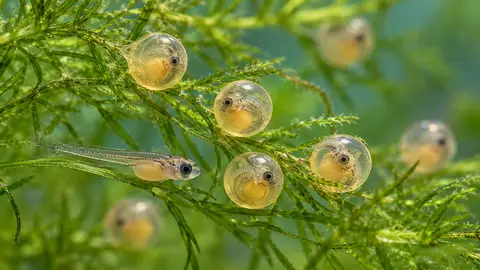
How Long Do Goldfish Eggs Take to Hatch?
Water temperature sets the pace. Compare hatch times measured at five temperatures, learn the signs eggs are on track, and see why some never hatch.
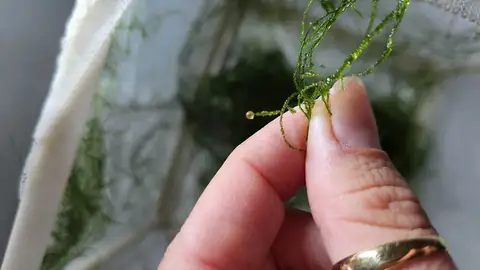
What to Do When Goldfish Lay Eggs
Found eggs after a spawn? Protect them from the adults, prepare a nursery, and recognize when the young are ready for their first food.

How to Make a Spawning Mop for Goldfish
Turn acrylic yarn into an egg-collecting tassel with a book, scissors, and a suction cup. Follow the steps and check the finished mop before use.